
Updated February 10, 2026
Ancient is one of the newer maps in the competitive pool, but it’s already earned its place with unique verticality and tight chokepoints. The Aztec-themed setting isn’t just for show – this map demands precise callouts because teams can hit you from multiple angles and elevations. One wrong call and your rotation is too late.
![Funny [YELLOW] Case case cs go](https://rs.bloodycase.com/?url=cdn.bloodycase.com/cases/1475894062878822400.webp&w=370&h=336&output=webp&q=100)
![Funny [RED] Case case cs go](https://rs.bloodycase.com/?url=cdn.bloodycase.com/cases/1475893882817351680.webp&w=370&h=336&output=webp&q=100)
![Funny [PURPLE] Case case cs go](https://rs.bloodycase.com/?url=cdn.bloodycase.com/cases/1475893755763494912.webp&w=370&h=336&output=webp&q=100)
![Funny [BLUE] Case case cs go](https://rs.bloodycase.com/?url=cdn.bloodycase.com/cases/1475894282886844416.webp&w=370&h=336&output=webp&q=100)
![Funny [GREEN] Case case cs go](https://rs.bloodycase.com/?url=cdn.bloodycase.com/cases/1475894570033090560.webp&w=370&h=336&output=webp&q=100)
Unlike simpler maps, Ancient has layers. Mid control matters, but so does knowing whether enemies are top or bottom on key positions. You need to be specific about height, not just location. A player on Ramp means something completely different from a player at Top Mid.
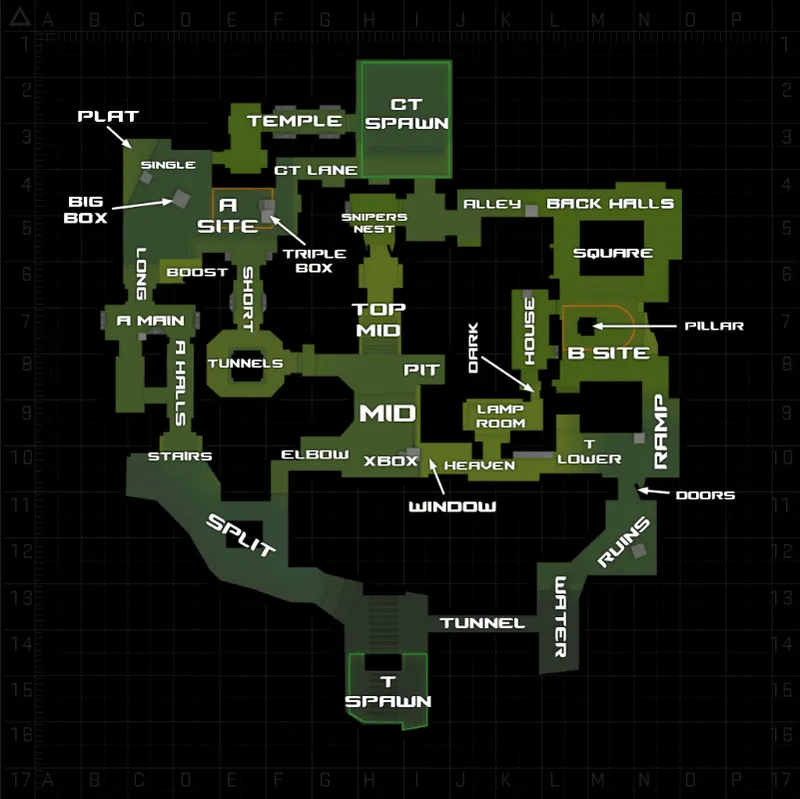
List of All Ancient Callouts
T Spawn Area
- T Spawn – Terrorist starting position in the temple ruins. Players usually split between Mid and B from here.
- T Stairs – The stone staircase leading up from T Spawn toward Mid. Important early control point.
- Alley – Narrow passage connecting T Spawn to B site. Gets smoked frequently to block CT aggression.
Mid Section
- Mid – The central corridor connecting both sites. Control here is crucial for map dominance.
- Top Mid – Upper level of Mid near the temple entrance. Where CTs often hold early rounds.
- Bottom Mid/Lower Mid – The lower pathway through Mid. Connects directly to Cave and Donut.
- Cave – The dark underground tunnel leading from Mid toward A site. Watch for CT pushes through here.
- Donut – Circular area with the large column in Mid. Named for its distinctive round shape. Also called Pillar.
- Mid Cubby – Small alcove on the side of Mid. Common spot for T lurkers or CT off-angles.
A Site
- A Site – The bomb site itself. Has multiple entry points and elevation changes.
- A Main – Primary entrance to A from Mid through the temple structure. High ground position.
- Ramp/A Ramp – The sloped pathway leading down into A site from Main. Critical chokepoint.
- Cubby – Small corner near the ramp on A site. Easy to miss when clearing.
- Default – Standard plant position on A, usually near the boxes for cover during defuse.
- Boxes – The stacked crates on A site. Provides cover and common plant spot.
- Temple/Temple Stairs – The elevated temple structure overlooking A. Where CTs often hold from.
- Pit – Sunken area on A site. Dangerous spot that requires specific clearing.
- Jungle – The pathway connecting Cave to A site through foliage. Named for the vegetation.
B Site
- B Site – The second bomb site. Features significant elevation differences.
- B Main – Primary T entrance to B through the corridor. Gets heavily util-ed.
- Elbow – The corner turn in B Main before entering site. Critical pre-fire spot.
- Walkway/Catwalk – Elevated platform running along B site. Key defensive position for CTs.
- Pillar – Large stone column on B site. Provides cover and common hold position.
- Back Site/Back B – The rear area of B site near CT spawn. Where rotators arrive from.
- Window – The window opening onto B site from CT side. Strong holding angle.
- B Default – Standard plant location on B, usually in the open area for post-plant positioning.
- Ramp/B Ramp – Sloped area on B leading to lower positions. Not to be confused with A Ramp.
CT Spawn Area
- CT Spawn – Counter-Terrorist starting position. Central location for rotations.
- CT Mid – The CT approach to Mid control. Important for early map presence.
- Red – Area with red-colored walls near CT spawn. Quick reference point for rotations.
Alternative and Regional Callouts
Some callouts vary by region or team preference:
- Donut vs Pillar – Both refer to the round structure in Mid. Donut is more common in NA, Pillar in EU.
- Temple vs Top A – The elevated position overlooking A site. Temple is more descriptive.
- Catwalk vs Walkway – Both describe the elevated path on B. Catwalk is shorter and more common.
- Bottom Mid vs Lower Mid – Same location, just preference. Bottom is slightly more common.
- Jungle vs Connector – The path from Cave to A. Jungle stuck because of the plants.
Tips from Professionals on Ancient Callouts
- Call elevation – Don’t just say Mid. Top Mid and Bottom Mid are completely different threats. Height matters on this map more than most.
- Be specific on B – Walkway, Pillar, Window, and Back Site need clear calls. B has too many angles to be vague.
- Cave pushes need instant calls – If CTs push Cave, your team needs to know immediately. It cuts off A Main completely.
- Donut control wins rounds – This spot gives info on both sites. Call when you have it and when you lose it.
- Count players on Walkway – Multiple enemies there can lock down B entirely. Your team needs numbers.
- Temple angles are deadly – When calling A, mention if enemies are Temple or on site level. Changes everything for retakes.
- Alley smokes matter – Call when Alley is smoked. Affects B timing and CT aggression potential.
- Mid control isn’t binary – You can have Top but not Bottom or vice versa. Be specific which part you control.
- Ramp calls need context – A Ramp and B Ramp are different. Always specify which site.
- Watch crossfires – Ancient has brutal crossfire setups. Call enemy positions so teammates don’t peek into multiple angles.
Ryan writes most of the articles on Bloodycase about the best skins, explanations of float values, spray patterns, and analyses of the settings used by professional CS2 players, among other topics. He got into this a few years ago while playing CS2 at the amateur level, and since then he’s continued to study more and more about what’s going on and how to play better.
When he’s not writing, he’s usually poring over a ton of material or arguing with friends about whether a particular skin is truly rare or just being heavily pushed. He likes playing on the terrorist side because they have the AK-47.