

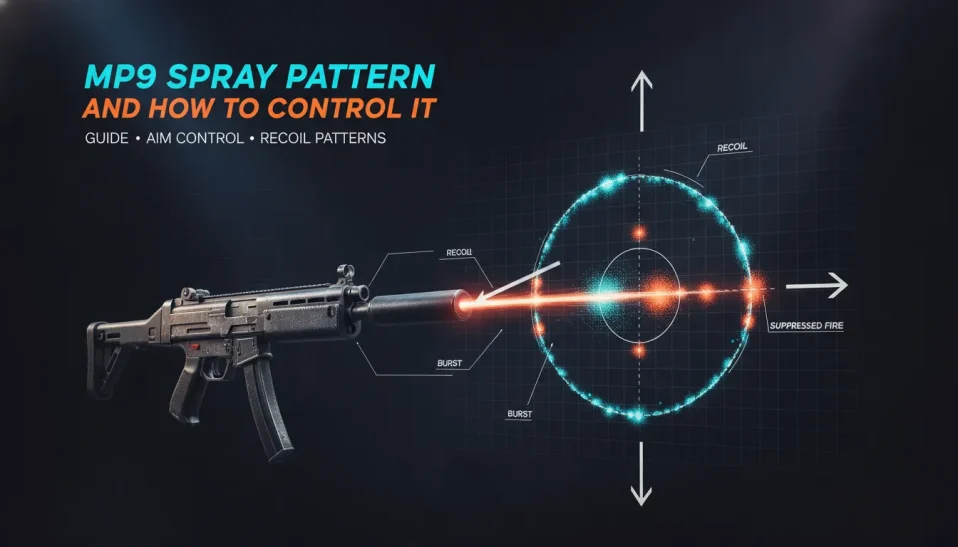
The MP9 is what a CT buys when the round is already going badly and there is still a way to win it. It is cheap, it fires fast, it moves well, and it pays $600 a kill. It is also a close-range weapon on a side whose entire job is normally holding distance, and that contradiction is the interesting part of playing it. An MP9 round asks you to stop being a Counter-Terrorist for ninety seconds. At BloodyCase, this guide covers how it shoots, where it works, and how to unlearn the habits that get MP9 players killed.
![Funny [YELLOW] Case case cs go](https://rs.bloodycase.com/?url=cdn.bloodycase.com/cases/1475894062878822400.webp&w=370&h=336&output=webp&q=100)
![Funny [RED] Case case cs go](https://rs.bloodycase.com/?url=cdn.bloodycase.com/cases/1475893882817351680.webp&w=370&h=336&output=webp&q=100)
![Funny [PURPLE] Case case cs go](https://rs.bloodycase.com/?url=cdn.bloodycase.com/cases/1475893755763494912.webp&w=370&h=336&output=webp&q=100)
![Funny [BLUE] Case case cs go](https://rs.bloodycase.com/?url=cdn.bloodycase.com/cases/1475894282886844416.webp&w=370&h=336&output=webp&q=100)
![Funny [GREEN] Case case cs go](https://rs.bloodycase.com/?url=cdn.bloodycase.com/cases/1475894570033090560.webp&w=370&h=336&output=webp&q=100)
MP9 at a Glance
| Side | Counter-Terrorists only. Terrorists can use it only by picking one up |
| Price | $1,250 |
| Kill reward | $600 |
| Magazine | 30 rounds, 120 in reserve |
| Rate of fire | 857 rounds per minute |
| Effective range | Close. Unreliable past short distances |
| Armour penetration | Low |
The fastest fire rate of any SMG, paired with the shortest patience. Thirty rounds at 857 per minute is roughly two seconds of gun.
The Economics: Why This Gun Exists
Work the arithmetic once and the whole weapon class makes sense.
A MP9 costs $1,250. Every kill pays $600. Two kills means you have earned $1,200 on a $1,250 purchase, on a round you were otherwise going to spend nothing and win nothing. Even if your team loses that round, you personally walk into the next one with more money than the rifle player who died for $300.
This is the actual design of the category. The kill reward exists to give a losing team a route back into the match that does not depend on winning a round outright. That is why the correct way to think about an eco round is not ‘can we win this’ but ‘how much damage and money can we extract’. Two kills and a lost round is a good eco. Zero kills and a lost round is two lost rounds, because you are broke again next time.
For a CT side this matters more than it does for Ts, because CT rounds are more expensive to play properly. A full CT buy wants a rifle, armour, a defuse kit and utility, and losing two rounds in a row means you cannot afford that combination. Four MP9 kills across an eco round is the difference between a full buy and another half buy, and half buys are how CT sides lose halves.
How the MP9 Spray & Recoil Patterns Works
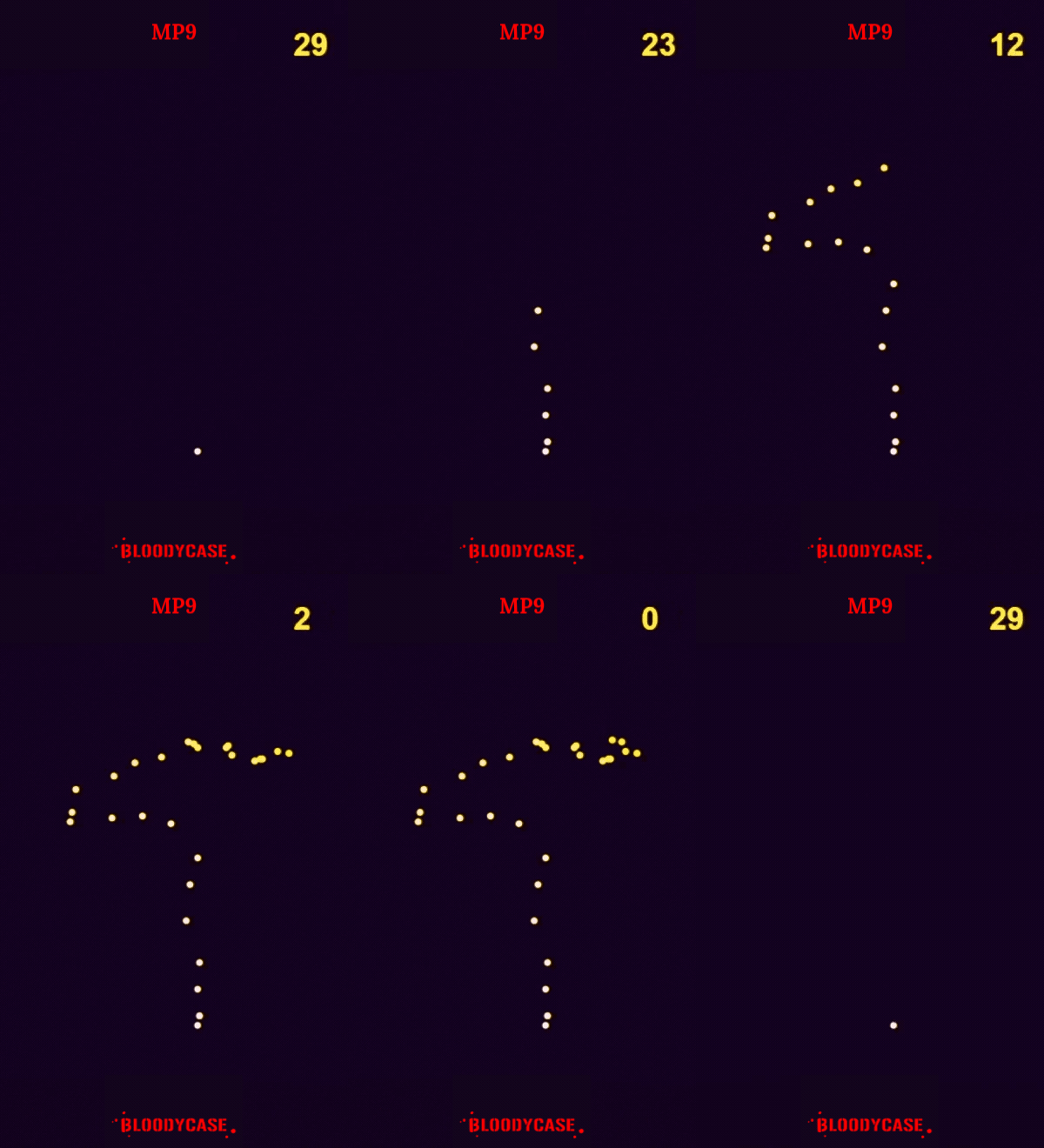
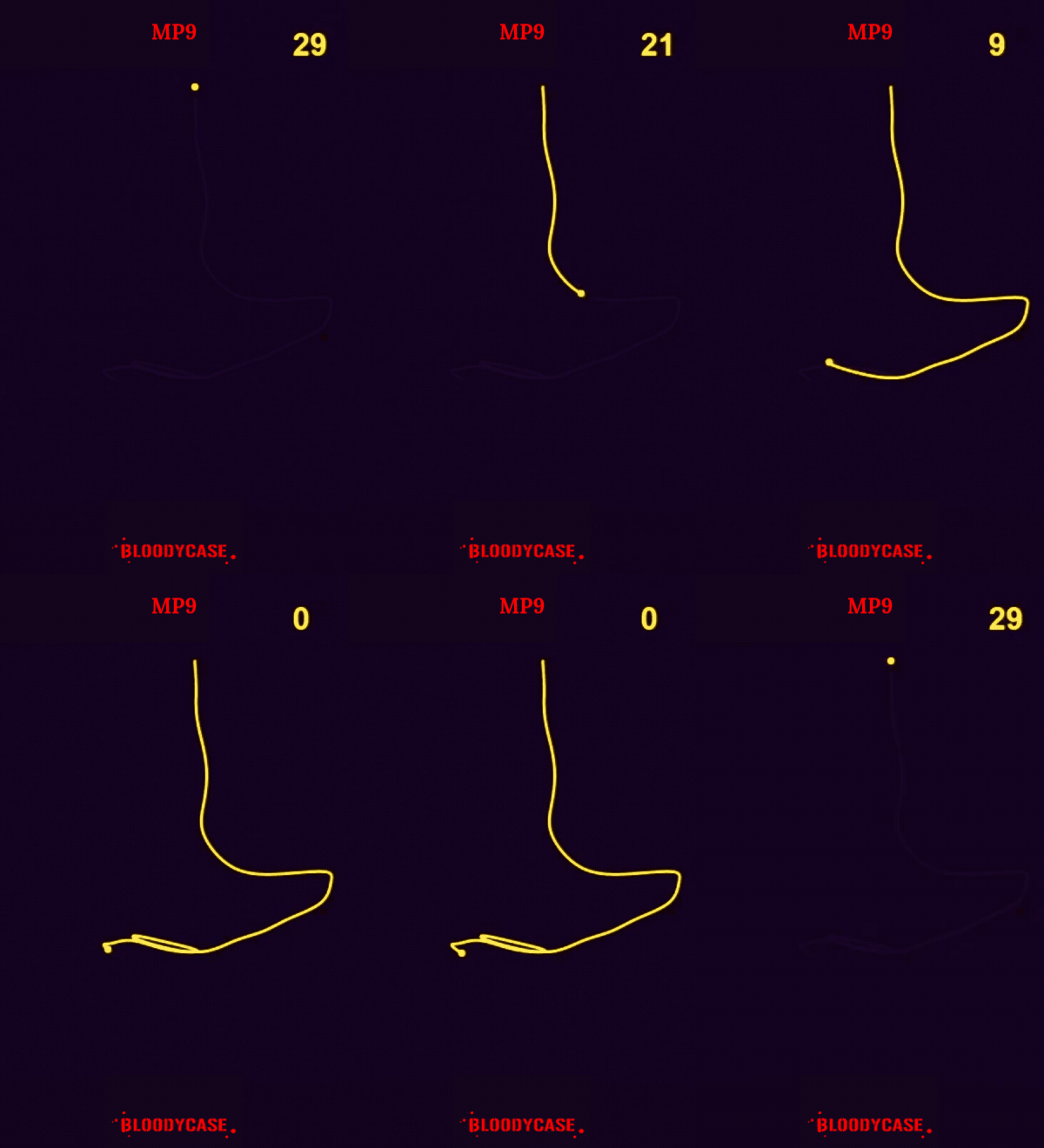
The MP9 follows a fixed recoil path that repeats every magazine, with a small random spread applied to each individual bullet on top of it. Learn the path, accept the spread.
The defining feature is speed. The MP9 fires faster than anything else in the class, which means the pattern arrives faster than your hand expects and the magazine is gone before you have finished reacting to it. The pattern itself is not difficult, and if you have controlled a rifle you can control this. What you have to adjust is the timing: everything happens roughly twice as fast, so your pull starts earlier and finishes sooner.
Trigger discipline is the practical skill, not pattern control. Thirty rounds at this rate disappears in a blink, and an MP9 player who empties the magazine at the first sound they hear is an MP9 player reloading when the fight actually starts.
Recoil Behaviour
| Bullets | What the gun does | What you do |
|---|---|---|
| 1 to 10 | Very fast vertical climb | Pull down early. This is where the round is decided |
| 11 to 20 | Flattens out, starts wandering horizontally | Correct laterally, or stop and reassess |
| 21 to 30 | Loose, then empty, very quickly | Release and reload |
Damage, Armour and Why Range Kills You
Every SMG shares the same two limits, and understanding them explains almost every unfair-feeling death you will have with one.
The first is damage per bullet against armour. Armour does not just absorb damage, it changes how much of each bullet gets through, and SMG bullets have low armour penetration. Against an unarmoured opponent an SMG kills fast enough to feel like a rifle. Against a kitted opponent the same burst leaves them alive and shooting back. This is why SMG rounds against a saving enemy feel incredible and SMG rounds against a full buy feel hopeless: it is the same weapon and a completely different equation.
The MP9 shares the MAC-10’s problem: low damage per bullet, offset only by how quickly you can deliver it. Against a full T buy with armour, your first burst is often not enough, and the second burst is the part of the duel where you find out whether your position was good.
The second is damage falloff over distance. Bullets do less damage the further they travel, and this is on top of the accuracy problem. So at range you are landing fewer bullets and each one that lands is worth less. Those two effects multiply rather than add, which is why SMG performance does not decline gently with distance, it collapses.
Put together: the MP9 has a distance past which it stops being a weapon and starts being a noise. Every good SMG player knows roughly where that line is on the maps they play, and simply never fights past it.
Effective Range at a Glance
| Distance | What is happening | What to do |
|---|---|---|
| Very close | The fire rate wins duels before the opponent’s pattern matters | Take the fight. Hold the trigger, aim upper chest |
| Short | Still good, but armoured Ts survive your opening burst | Only with an angle advantage or a teammate trading you |
| Medium | Accuracy and damage both fall away. Rifles win by default | Do not take this fight. This is not a CT angle any more |
| Long | You are announcing your position and doing nothing else | Do not fire |
Movement Accuracy Is Your Real Advantage
This is the mechanic the whole weapon class is built on, and most players who buy SMGs never consciously use it.
Every weapon in CS2 gets less accurate while you move, but the penalty is not applied equally. Rifles are punished severely: a rifle fired at a run is close to a random number generator, which is why rifle play is built around counter-strafing, planting your feet and taking the shot from a standstill. SMGs are punished far less. You still shoot better standing still, but the gap between moving and stationary is small enough that an SMG player can do things a rifle player mechanically cannot.
What that buys you in practice is timing. A rifle player peeking an angle has to arrive, stop, settle and shoot, and that whole sequence is a window their opponent can shoot into. With the MP9 you can arrive and shoot, and the window closes faster. You can peek wider without punishing yourself, you can strafe through an angle rather than stopping in it, and you can take a fight from a body position the opponent has not pre-aimed. Against an enemy expecting rifle rhythms, that is genuinely disorienting.
The trap is reading this as permission to run and gun. It is not. It is permission to be less still than a rifle, which is a smaller and more specific advantage than it sounds. Use it to control when the fight starts, not to replace aiming.
Standing still is a mechanic rather than a decision, and the mechanic is counter-strafing. If you are strafing right with D, you tap A for an instant and your velocity drops to zero almost immediately, and a bullet fired on that frame is accurate. Simply releasing D leaves you sliding for a moment. Every SMG rule above still sits on top of this: move to get somewhere, stop to shoot when you can, and use the movement advantage for the times you cannot.
The Hard Part: Playing CT Against Your Instincts
Everything you have learned about holding a site says the same thing: take the angle, hold the distance, make the T side come to you and punish them when they do. That is correct with an M4. It is close to suicide with an MP9, because holding distance means giving a rifle player a fight at rifle range, and you lose that fight roughly every time.
The MP9 round is the opposite. You want to be close, tucked into an angle the T side will not clear properly, at a depth their utility does not cover. You want the fight at four metres, on your terms, before they have any reason to think a CT is standing there. That is not a passive hold, it is an ambush, and it uses a different part of the map than your normal position does.
The other half is timing. Aggressive early positions catch T sides before they have set up, which is exactly when they are least able to punish you for being close. An MP9 player who takes an off-angle at the start of the round and kills the first man through is worth more than the same player holding site properly and dying to the third.
Key Principles
- Play aggressive, not passive. Your instincts are wrong for this round. Get close, take the tight angle, kill someone before they know a CT is there.
- Off-angles are everything. The T side expects a pistol at range or a rifle at range. An MP9 four metres inside a corner is a fight they have no plan for.
- Buy armour with it. $1,250 leaves room. Without a kit you die to the first Deagle bullet and the whole plan collapses.
- Two kills wins the eco. Play for money and damage. The round win is a bonus and is not worth dying for.
- Aim upper chest. Volume kills, not precision.
- Buy with the team. Five MP9s on an aggressive timing is a real strategy. One MP9 while everyone else saves is charity.
- Steal a rifle. The best MP9 round ends with you holding an AK. Play towards the trade and the pickup.
- Reload constantly. Two seconds of ammunition means you are almost always closer to empty than you think.
How to Practice Firing the MP9 in CS2
Three sessions. Most of it is unlearning rather than aiming.
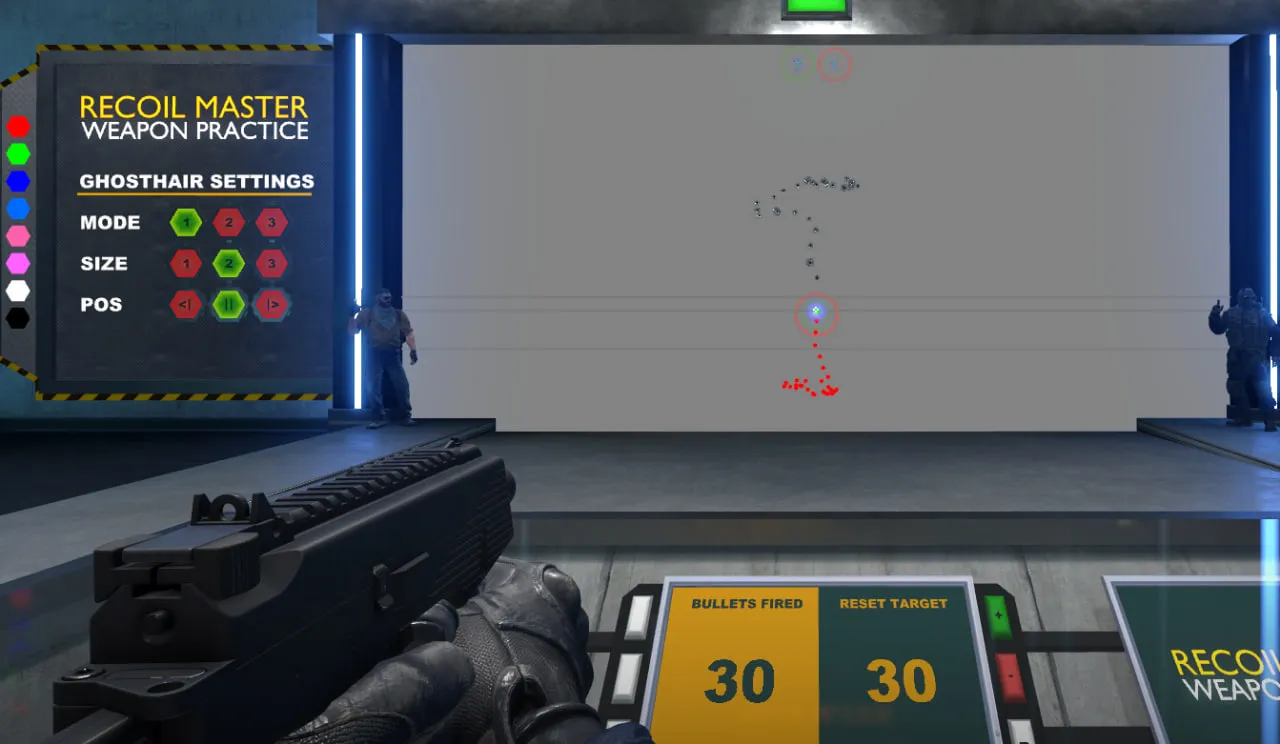
- Session 1, Feel the Speed: Full magazines into a wall from close range, roughly two player widths back. First without compensation, then with. The lesson is how much earlier your pull has to start compared to an M4.
- Session 2, Moving Peeks: aim_botz, close bots, wide fast peeks while strafing. Fire without a full stop and watch how much you still hit. Then repeat the drill with an M4A1-S and compare. That gap is what you bought.
- Session 3, Aggressive Positions: Deathmatch, MP9 only, and force yourself to close distance on every engagement rather than holding. If you catch yourself standing still at range, you are playing old habits with a new gun.
Frequently Asked Questions
The MP9 is cheaper and faster, the MP7 costs more and holds up better at slightly longer range. On a true eco the MP9 is usually right, because the point is spending little and earning much. If you have money to spare and expect awkward middle-distance fights, the MP7 justifies the difference.
Ask your team, not a guide. If everyone is buying, buy. If everyone is saving, save. A split eco where two players buy SMGs and three save loses the round and the economy simultaneously, which is the worst available outcome.
Because you are playing it like a CT weapon. Holding a long angle with an MP9 hands a rifle a free kill from a distance you cannot answer. Get closer than feels safe, use an angle they will not clear properly, and let them walk into you.
Very. Against unarmoured opponents the low damage per bullet stops mattering, the fire rate does all the work, and you collect $600 a body while risking $1,250. Anti-eco is arguably a better MP9 round than an actual eco is.
Armour, on almost every round. Utility helps you win a round you might not win anyway. Armour helps you survive to trade, to do damage, and to pick up a rifle, which are the three things an eco round is actually for.

Ethan is the Chief Editor at BloodyCase. He has been playing Counter-Strike since the 1.6 era and started writing about the game almost by accident – at first, he posted analyses of updates and patches on forums, and he never stopped. He’s in charge of editorial content: he decides what to write about, checks the accuracy of articles before publication, and keeps track of how the game is changing to ensure that the information on BloodyCase is always up-to-date and interesting.
He’s still playing CS2 and annoying everyone with his AWP skills.