

Cobblestone map got tricky ups and downs, and the spots where you plant bombs are kind of complicated, which can be a lot, even if you’ve been playing for a while. Now that the map has returned to CS2, it looks better but still has the same smart design that made it a favorite among serious players.
![Funny [YELLOW] Case case cs go](https://rs.bloodycase.com/?url=cdn.bloodycase.com/cases/1475894062878822400.webp&w=370&h=336&output=webp&q=100)
![Funny [RED] Case case cs go](https://rs.bloodycase.com/?url=cdn.bloodycase.com/cases/1475893882817351680.webp&w=370&h=336&output=webp&q=100)
![Funny [PURPLE] Case case cs go](https://rs.bloodycase.com/?url=cdn.bloodycase.com/cases/1475893755763494912.webp&w=370&h=336&output=webp&q=100)
![Funny [BLUE] Case case cs go](https://rs.bloodycase.com/?url=cdn.bloodycase.com/cases/1475894282886844416.webp&w=370&h=336&output=webp&q=100)
![Funny [GREEN] Case case cs go](https://rs.bloodycase.com/?url=cdn.bloodycase.com/cases/1475894570033090560.webp&w=370&h=336&output=webp&q=100)
If you want to master Cobblestone well, you can’t just memorize the names of places. Knowing the positions gives you a real advantage, because accurately determining the location of your enemies can determine whether you win the round or lose control of the map.
This guide from the BloodyCase team will tell you all the important callouts you need to know to be great on Cobblestone in CS2. It covers everything from the basic names of spots to more advanced calls that will help your team play smarter.
What Are Callouts and Why You Need Them on Cobblestone
Callouts are short, specific location names on the map that teams use for quick and clear communication during matches. On Cobblestone, with its complex multi-level structure, vertical gameplay, and long sightlines, effective communication becomes critically important.
Proper use of callouts enables instant information sharing about enemy positions, significantly impacting team coordination, attack timing, and strategic planning. For example, when a CT player timely calls “Enemy Long A!”, it gives the team an opportunity to quickly rotate and intercept the terrorists before they can plant the bomb. Such timely callouts often determine the round outcome.
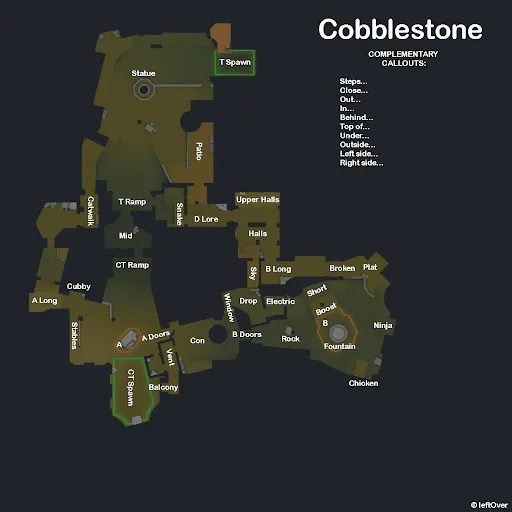
Full Cobblestone Callouts for T Side
For terrorists, knowing precise location names is fundamental for successful attacks on Cobblestone:
Spawn and Initial Movement
- T Spawn: Your starting position, where you buy utility and plan executes.
- T Ramp: The main exit from spawn leading toward mid map control.
- Statue: The monument area near T spawn, good reference point for early rotates.
- Patio: Open area adjacent to spawn, watch for early CT aggression here.
Mid Control and Rotations
- Mid: Central map control, absolutely crucial for rotations and map presence.
- Catwalk: Elevated walkway in mid area, key for controlling rotations.
- Upper Halls: Upper level connecting areas, important for quick site switches.
- Halls: Main hallway system, primary route for B approaches.
- D Lore: Connector area between upper sections.
A-Site Approach
- A Long: Primary corridor to A-site, standard route for A executes.
- Stairs: Staircase leading to A areas, watch for CT rotates.
- A Doors: Main entrance to A-site from Long.
- A: The actual A bombsite.
- Balcony: Elevated position overlooking A-site.
- CT Spawn: Back area of A-site where CTs rotate from.
B-Site Approach
- B Long: Main B approach through the tunnel system.
- Drop: Drop-down access point, crucial for B splits and flanks.
- Window: Window area providing sightlines into B.
- Electric: Electrical room area near B approaches.
- B Doors: Main B-site entrance.
- B: The B bombsite itself.
- Rock: Stone cover on B-site.
- Fountain: Central fountain on B-site, common plant spot.
Advanced Positions
- Broken: Broken wall area, good for off-angles.
- Plat: Platform area overlooking B.
- Short: Shorter route to B-site.
- Boost: Boost spot for elevated angles.
- Ninja: Hidden position for sneaky plays.
- Chicken: Back area of B-site.
- Sky: Upper level positions.
- Cubby: Small hiding spot near A.
- Con: Connector between areas.
- Vent: Ventilation area for rotations.
These callouts give you everything needed for precise info sharing, coordinated site takes, and mid-round adaptations. Master these spots and your team’s communication will be on point for every Cobblestone match.
Full Cobblestone Callouts for CT-Side
Based on the official Cobblestone callout map, here are all the essential CT-side positions you need to know for solid defensive setups.
Spawn and Initial Positions
- CT Spawn: Your starting position behind A-site, main fallback area for A rotates.
- CT Ramp: The ramp leading from CT spawn toward mid map control.
- Balcony: Elevated position overlooking A-site, crucial for A defense and long angles.
A-Site Defense
- A: The A bombsite itself, primary defensive zone.
- A Doors: Main choke point from A Long, key holding angle.
- Stairs: Staircase near A-site, important for rotations and flanks.
- Cubby: Small corner near A-site, good for close angles and anti-eco rounds.
- A Long: Long corridor approach to A, where you take early picks.
- Vent: Ventilation area for rotations between sites.
- Con: Connector area, crucial for mid-round rotates.
Mid Control and Rotations
- Mid: Central area, essential for map control and rotation timing.
- Catwalk: Elevated walkway in mid, key for controlling T rotations.
- Upper Halls: Upper level connecting different map areas.
- D Lore: Connector between upper sections, important for quick rotates.
- Halls: Main hallway system leading to B approaches.
B-Site Defense
- B: The B bombsite, secondary defensive zone.
- B Doors: Main entrance to B-site, primary holding angle.
- Rock: Stone cover on B-site, common defensive position.
- Fountain: Central fountain on B-site, key for post-plant positions.
- Boost: Boost spot for elevated defensive angles.
- Short: Shorter approach to B-site, watch for quick rushes.
- Plat: Platform overlooking B-site, crucial for site retakes.
- Broken: Broken wall area, good for off-angles and surprise plays.
Advanced Defensive Positions
- Drop: Drop area where Ts can flank, crucial to watch during B defense.
- Electric: Electrical room near B, common spot for late rotates.
- Window: Window providing sightlines into B approaches.
- B Long: Long B approach through tunnels, where you can get early info.
- Ninja: Hidden spot on B-site for sneaky defensive plays.
- Chicken: Back corner of B-site, good for saving and clutch situations.
- Sky: Upper level positions for advanced angles.
- Statue: Monument area, reference point for callouts and rotations.
- Patio: Open area where you can catch rotating Ts.
Rotation Routes
- T Ramp: Area you can control to cut off T rotations.
- Squeaky: Narrow passage that gives audio cues for enemy movement.
- Vent: Alternative rotation route between sites.
For counter-terrorists, precise callouts form the foundation of effective defense: Consistent use of these callouts significantly reduces confusion during retakes or site holds, enabling CT teams to react swiftly to terrorist movements, coordinate rotations effectively, and relay early information about enemy positioning.
Pro tips for quickly learning Cobblestone callouts
To quickly learn Cobblestone callouts, try these methods:
- Practice alone by walking around the map and saying each location name out loud.
- Use callout maps with labeled spots that you can find or make.
- Connect location names to what you see: for instance, “Chicken Coop” is easy to recall because of the chicken cage.
- Play with skilled players and carefully listen to how they use callouts.
- When watching pro games, focus on how teams communicate.
Repeating, playing often, and talking with your team consistently will help you learn faster and remember callouts better.
Why Cobblestone callouts remain crucial in CS2
Using the same callouts helps teams react faster to what the enemy does, makes communication smoother, and lets teams change their plans to beat the other team. In CS2, the game is faster and the graphics are better, so clear callouts are even more important for winning.
Teams that know the Cobblestone callouts well have a big edge in working together. This can be the thing that helps them win important moments and tough games.

Ryan writes most of the articles on Bloodycase about the best skins, explanations of float values, spray patterns, and analyses of the settings used by professional CS2 players, among other topics. He got into this a few years ago while playing CS2 at the amateur level, and since then he’s continued to study more and more about what’s going on and how to play better.
When he’s not writing, he’s usually poring over a ton of material or arguing with friends about whether a particular skin is truly rare or just being heavily pushed. He likes playing on the terrorist side because they have the AK-47.